Pet obesity has been a growing problem for many years, in fact it is estimated that 65% of dogs and 39% of cats have overweight or obesity.1,2 Given the impact overweight or obesity has on pet health (obesity is linked to an increased risk of developing several conditions including joint disease, diabetes mellitus and urinary disorders)3,it comes as no surprise that owners of overweight cats and dogs spend more on health care costs than owners whose pets are at an ideal weight4. However, what you may not be as aware of are the hidden costs associated with obesity.
Cats and dogs with overweight or obesity may have a reduced life expectancy, with studies indicating that it may be as much as 2.5 years less in dogs5, and just under 2 years in cats6.
All this begs the question, what can you as a pet owner do to help maintain your pet’s weight? And if your pet has obesity, what steps can you take to help them return to a healthy weight? Caroline Burke, BSc, NCert(SAN) RVN, and Health Affairs Manager (UK&I) at Royal Canin, answers these and other questions for us.
The importance of regularly weighing and assessing your pet’s body weight and shape
Do you know what your pet’s current weight is? Do you know how to assess their body shape using Body Condition Scoring?
Veterinary clinics and many pet shops have walk on scales available for dogs and whilst taking a cat to the vet to be weighed can be more challenging, there is a lot you can do to help make a trip to the vets run more smoothly.
If you know your pet’s current weight, but are unsure about their Body Condition Score, you are not alone. The PDSA PAW report in 2023 found that 68% of dog owners and 47% of cat owners knew their pet’s current weight, whereas only 20% of dog owners and 16% of cat owners knew their pets Body Condition Score.7
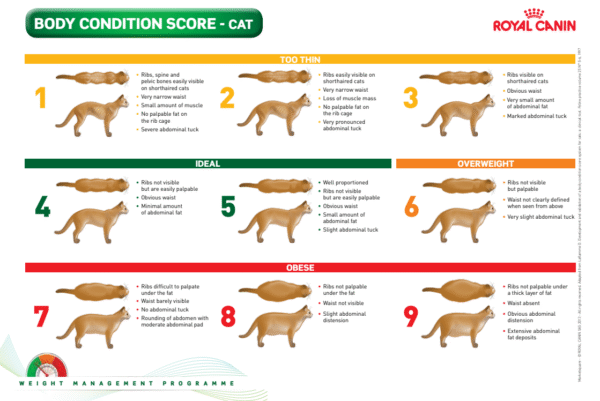
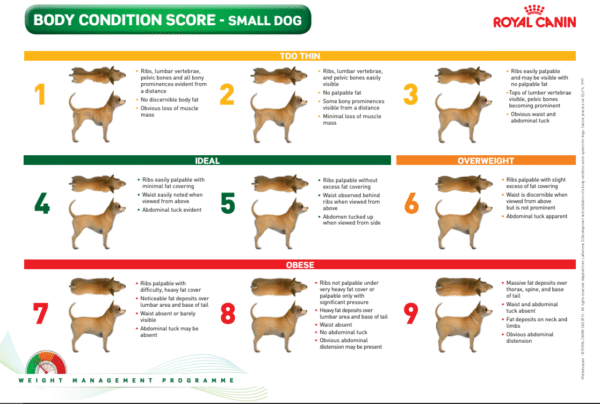
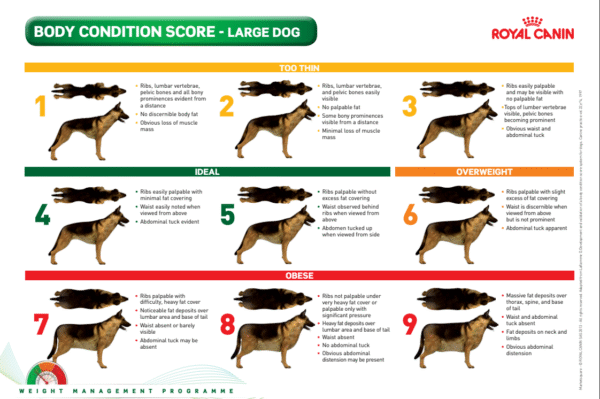
Every cat and dog is an individual and like us, so is their body shape. A technique called Body Condition Scoring (BCS) is used to assess a cat or dog’s shape, using a 9-point scale. As different breeds of dogs put on weight in different places, Royal Canin have further developed the 9-point BCS scale by creating 6 different BCS charts for dogs and one for cats. Performing a BCS involves looking at, and feeling, three key areas of their body:
- How easily can you feel their ribs using a feather light touch? If you have to press a bit more firmly to feel their ribs, then it’s time to take action!
- What waist definition can you see and feel? You should be able to see and feel the indentation of your cat or dog’s waist behind their ribs.
- How easily can you see and feel a diagonal tummy tuck?
Once you have completed your visual and hands-on assessment of your pet’s shape, you can compare it the images on the 9-point BCS scale to determine what score they are:
- BCS 1-3: your pet is underweight
- BCS 4-5: your pet is at ideal weight
- BCS 6: Your pet is above ideal weight
- BCS 7-9: Your pet has overweight or obesity
What do I do if my pet’s Body Condition Score is 7 or above?
If your pet’s body condition score is 7 or above, then it’s time to speak to your veterinary team; they are best placed to be able to advise you on how you can help your pet return to a healthy weight and shape. Many veterinary practices offer dedicated weight management clinics, which means they can offer one to one support and work with you to build a plan tailored to your pet’s needs.
One key area that your veterinary team will focus on is nutrition, because to support weight loss, a reduction in your pet’s daily calorie intake is required. Whilst energy restriction is required to help support weight loss, this can cause several concerns including that your pet will be hungry, you may see an increase in begging or food-seeking behaviour or your pet may eat their food quickly8,9. You would not be alone in expressing these concerns, these are all common concerns shared by many owners8,9 and there are strategies your veterinary team can recommend to help address them.
As a starting point, your veterinary team may recommend changing your pet onto a specifically formulated weight management diet, such as ROYAL CANIN® SATIETY WEIGHT MANAGEMENT. The diets within this range are complete and balanced, meaning they meet your pet’s nutritional requirements, but have an adapted protein and fat content to support weight loss, whilst a high natural fibre level helps keep cats and dogs satisfied between meals.
Your veterinary team may also discuss if you want to feed dry food, wet food, or a mix of both. Dry food has many benefits; it doesn’t spoil in the bowl and by its very nature, it contains less moisture than wet food making it more energy dense10, which also means it is often a cost-effective way to feed your pet. The kibble can also be adapted to meet specific needs, for example, the ROYAL CANIN® CANINE SATIETY WEIGHT MANAGEMENT diet has a cross shaped kibble, which helps slow down the speed of ingestion and increases meal duration11; characteristics which are beneficial for dogs on a weight loss programme.
However, don’t discount wet food!
As well as offering a different texture and aroma profile, the high moisture content of wet food helps dilute calories and means the portion size will be bigger12; which may help to support a feeling of fullness. Mixed feeding can therefore be a great benefit to cats and dogs on a weight loss programme, with one study reporting that 86% of cat owners who usually feed dry food only, found that a combination of wet and dry made the weight loss programme more interesting, and even more striking was that 50% felt less guilty about the calorie restriction necessary to support weight reduction.13
To support your pet’s feeding preferences, the ROYAL CANIN® SATIETY WEIGHT MANAGEMENT range includes diets for cats and dogs in both a dry format (including one specifically for Small Dogs) and a wet format (loaf for dogs and thin slices in gravy for cats).
In addition to nutrition advice, your veterinary team may well recommend other steps that you can take to help your pet return to a healthy weight and shape.
What else might my veterinary team recommend?
1. Use digital food scales to measure your pet’s daily food portion
Using a scoop, measuring cups and giving handfuls of food normally result in feeding too much or too little food. If your pet is on a weight loss programme, it is critical that they are fed the same amount of food (and calories) every day. Not only does using digital food scales ensure your pet gets the exact daily portion they need, but it also ensures the bag of food will last for the correct length of time!
2. Advice on treats/extras/rewards/scraps/human food
Anything that you feed your pet will contain calories and giving your pet extras as well as their daily food portion can contribute to weight gain and may limit weight loss. Giving pets extras such as treats, chews, human food etc. is very common and is often driven by emotions rather than nutritional need; in fact, one report found that 48% of owners gave treats because they believed it made their pet happy, 29% because it made them themselves happy and 14% because their pet was begging.14
As part of your pet’s weight management programme, your veterinary team may offer different options for managing treats/extras, rewards and new strategies for how to respond to begging or food-seeking behaviours.
As a general guide, treats/extras and rewards should make up not more than 10% of your pet’s daily calorie allowance. A great way to make sure that you are not going over this amount is to set aside the agreed number of treats allowed or use part of their daily food portion as treats.
Your veterinary team may also recommend swapping out some of your pet’s higher calorie treats for lower calories ones. For example, ROYAL CANIN® Satiety Treats for dogs are low calorie (less than 3Kcal per chew) and can be fed alongside any of the ROYAL CANIN® CANINE SATIETY WEIGHT MANAGEMENT diets. Just make sure you don’t exceed the total daily number of treats that can be given!
Your veterinary team may also recommend that rather than responding with food when your pet displays begging or food-seeking behaviours, that you respond with something else. For instance, you could groom your cat or dog or have a play session with them. Not only do these options offer an opportunity to bond with your pet, but they have the added benefit of not containing any calories!
3. Make mealtimes fun!
Cats and dogs are known as “contra-freeloaders.” In other words, they prefer to work for their food. So why not ban the bowl to make feeding time more stimulating!
There is a wide variety of interactive feeders available and not only are they a great way of providing mental stimulation for your pet, but they can also encourage gentle exercise and help to slow down fast eaters. If your pet has never experienced interactive feeding before, then make sure you start with a simple feeder first, then build up to a more complicated design.
4. Exercise plans
Your veterinary team may recommend changes to your pet’s exercise routine; for example, increasing the amount of exercise your pet is getting by adding an additional walk or play/training session. The exact exercise plan will differ from pet to pet, as it will be tailored to your pet’s needs and abilities.
What happens when my pet reaches their ideal weight and shape?
Weight re-gain after a successful weight loss programme is common in cats and dogs. In fact, nearly 50% of dogs who successfully complete a weight loss programme will re-gain weight15. It is therefore recommended that your pet remains on their weight management diet long term to help limit weight re-gain.
If my pet is at a healthy weight and shape, what I can do to keep them that way?
There are lots of steps that you can take to help maintain your pet at a healthy weight and shape, but one of the key steps is to weigh and Body Condition Score your pet regularly.
Research into obesity in humans has shown an association between frequency of weighing and maintaining bodyweight, as well as showing that when people on a weight loss program have been regularly weighed, there is greater weight loss and maintenance of weight loss.16
We therefore cannot underestimate the importance of regularly weighing and assessing your pet’s shape. Keeping an up-to-date record of your cat or dog’s weight in conjunction with BCS will enable you to spot when their weight starts to creep up and allow you to act early.
In addition to that, the advice is the same as for pets on a weight loss programme:
- Weigh out your pet’s daily food portion using digital scales
- Extras/treats/rewards should make up no more than 10% of your pet’s daily calorie allowance
- Respond to begging or food-seeking behaviours with low calorie options, use some of their normal kibble as a treat or offer an alternative (grooming/play)
- Ensure you have a consistent exercise plan in place
- Utilise interactive feeders to provide mental stimulation and slow down greedy eaters
Summary
Maintaining your pet at a healthy weight and shape is a key step in supporting their overall health and wellbeing. If your pet has overweight or obesity you do not have to tackle it on your own. Your veterinary practice will be able to offer you and your pet the support you need for successful weight reduction and feeding a diet that is specifically formulated to support weight loss, whilst also keeping your pet feeling full can help support your pet’s weight loss and weight maintenance journey.
References
1. German, A.J., Woods, G.T., Holden, S.L. et al (2018) Dangerous trends in pet obesity. Veterinary Record 182 (1).
2. Courcier, E.A., O’ Higgins, R., Mellor, D.J. et al (2010) Prevalence and risk factors for feline obesity in a first opinion practice in Glasgow, Scotland. Journal of Feline Medicine and Surgery 12 (10): 746-753.
3. German, A.J. (2006). The growing problem of Obesity in dogs and cats. The Journal of Nutrition 136 (7): 1940S-1946S.
4. Bomberg, E., Birch, L., Endenburg, N., German, A.J., Nielson, J., Seligman, H., Takashima, G., Day, M.J. (2017). The financial costs, behaviour and psychology of obesity: a one health analysis. Journal of Comparative Pathology 156 (4): 310-325.
5. Salt, C. Morris, P.J., Wilson, D., Lund, E.M., German, A.J. (2018). Association between life span and body condition in neutered client-owned dogs. Journal of Veterinary Internal Medicine 33 (1): 1-11.
6. Teng, K.T., McGreevy, P.D., Toribio, J.L., Raubenheimer, D., Kendall, K., Dhand, N.K. (2018). Strong associations of nine-point body condition scoring with survival and lifespan in cats. Journal of Feline Medicine and Surgery 20 (12): 1110-1118
8. Flanagan, J., Bissot, T., Hours M-A., et al (2017) Success of a weight loss plan for overweight dogs: The results of an international weight loss study. PLoS ONE; 12 (9): e0184199.
9. Serisier, S., Pizzagalli, A., Leclerc, L. et al (2014) Increasing volume of food by incorporating air reduces energy intake. Journal of Nutritional Science; 3 (59).
10. Butterwick, R. (2021). Calculating the energy content of pet food. Vet Focus, 24(3).
11. Sagols, E., Hours, M.A., Daniel, I., Feugier, A., Flanagan, J., German, A.J. (2019). Comparison of the effects of different kibble shape on voluntary food intake and palatability of weight loss diets in pet dogs. Research in Veterinary Science, 124: 375-382.
12. UK Pet Food Pet Food Formats Factsheet
13. Flanagan, J., Feugier, A., Vialle, S. (2017) A means for differentiation of the degree of satiety of low-energy, high-fiber wet products in cats. Proc. Of 17th Annual AAVN Clinical Nutrition and Research Symposium; National Harbour, USA.
14. PDSA Animal Wellbeing Report (2012)
15. German, A. J., Holden, S. L., Mather, N. J., Morris, P. J., Biourge, V. (2010). Low-maintenance energy requirements of obese dogs after weight loss. British Journal of Nutrition 106 (1): S93-S96.
16. VanWormer, J.J., French, S.A., Pereira, M.A. et al. The Impact of Regular Self-weighing on Weight Management: A Systematic Literature Review. Int J Behav Nutr Phys Act 5, 54 (2008).